
Financial Literacy: The Questions That Can Shape Your Financial Future
Financial success isn't just about how much money you earn. It is also about how well you understand the decisions you make with that money. Many people spend decades working, saving, contributing to retirement accounts, buying insurance, paying taxes, and supporting their families without ever receiving structured financial education. As a result, people often make important financial decisions one at a time rather than as part of a coordinated strategy.
Financial literacy can help change that. It begins with understanding a few fundamental concepts and asking better questions about your money.
How Long Could It Take Your Money to Double?
One of the most important concepts in personal finance is compound growth. When money earns a return and those returns begin generating additional returns, growth can accelerate over time. This is why time can be such a powerful financial resource.
The earlier you put money to work, the longer compounding has to operate. Delaying saving or investing may mean contributing considerably more later to reach the same goal. Understanding the relationship between time, rate of return, and regular contributions can help you make more informed long-term decisions.
What Is Inflation Doing to Your Purchasing Power?
Keeping money safe matters, but safety alone doesn't necessarily preserve purchasing power. Inflation gradually raises the cost of goods and services, so a dollar today may buy less ten or twenty years from now.
Housing, groceries, healthcare, transportation, education, and insurance can all become more expensive over time. This means financial planning is not simply about accumulating a certain dollar amount. It is also about what that money can actually buy in the future.
What Would Happen If Your Income Stopped?
For many families, income is one of their most valuable financial assets. Yet people often spend more time insuring their homes and vehicles than protecting the income that pays for them.
If your income stopped unexpectedly, how long could your household continue paying the mortgage, utilities, groceries, childcare, education expenses, and other obligations? Emergency savings are part of the answer, but depending on your circumstances, life insurance, disability income protection, and other risk management strategies may also be important.
Financial literacy is not only about growing money. It is also about protecting the financial foundation your family depends on.
Do You Understand How Your Money May Be Taxed?
Taxes can greatly affect long-term financial consequences, yet many people focus only on investment returns. Different accounts and financial strategies may be taxed differently.
Some money may be taxable as it grows. Other money may grow tax-deferred, with taxes generally due when you withdraw funds. Certain strategies may offer tax advantages if you meet specific requirements. Each type of money can serve a different purpose.
Understanding how taxes may affect both accumulation and retirement income can help you make better decisions about where and how you save.
How Much Income Will You Need in Retirement?
Many people approach retirement planning by asking how much money they should have saved. An equally important question is how much reliable monthly income they may need once they stop working.
Retirement does not eliminate everyday expenses. Housing, healthcare, food, transportation, travel, insurance, taxes, and family responsibilities can continue for decades. Retirement planning therefore involves more than accumulating assets. It also involves thinking about how those assets may eventually be converted into sustainable income.
That income may come from several sources, including Social Security, pensions, retirement accounts, personal savings, investments, annuities, or insurance strategies depending on the individual's circumstances.
What Happens When Life Does Not Follow the Plan?
A financial strategy may look excellent on paper until something unexpected happens. A serious illness, disability, premature death, job loss, long-term care need, major market decline, or new family responsibility can quickly change financial priorities.
These events can affect income, savings, retirement plans, and even assets intended for future generations. For that reason, a sound financial strategy should consider both growth and protection.
Sometimes protecting the plan matters as much as growing the assets within it.
Have You Thought About Long-Term Care?
People often view long-term care primarily as a healthcare issue, but it can also become a major financial and family issue. If someone eventually needs help with everyday activities such as bathing, dressing, eating, transferring, toileting, or continence, they may receive care at home, in assisted living, or in a nursing facility.
The financial impact may go beyond the individual receiving care. Family members may need to reduce work hours, travel frequently, temporarily leave employment, or take on caregiving responsibilities.
Planning before care is needed may give families more choices and control than waiting until a crisis occurs.
What Will Happen to the Wealth You Have Built?
Financial planning should not stop at retirement. Eventually, individuals and families also need to consider what happens to their assets after death.
Questions about beneficiaries, estate planning documents, wills, trusts, account ownership, and legacy wishes can all become important. A thoughtful plan can clarify your intentions and reduce unneeded confusion for the people you care about.
Building wealth matters, but understanding how that wealth may ultimately transfer is also part of financial literacy.
Financial Literacy Is Really About Better Decisions
You do not need to become a financial professional to improve your financial life. However, you do benefit from understanding the basic concepts that influence your money.
The real value of financial literacy is that it helps you ask better questions. How is my money growing? What is inflation doing to my purchasing power? Is my income adequately protected? How might taxes affect my retirement? What happens if I need long-term care? How will my assets eventually pass to my family?
You may not have every answer today. The important first step is recognizing which questions deserve attention.
How Many of These Questions Can You Answer Today?
Do you know how long it could take your money to double? Do you understand what compounding may do over ten, twenty, or thirty years? Do you know how inflation could affect your future purchasing power? If your income stopped tomorrow, how long could your family preserve its current lifestyle?
Do you understand the difference between taxable, tax-deferred, and potentially tax-advantaged money? Do you know how much income you may actually need during retirement? Have you considered how an unexpected illness, disability, or long-term care need could affect your plans? Do you have a strategy for transferring what you have built to the people or causes you care about?
If several of these questions are difficult to answer, financial education can be a good place to start.
Continue Your Financial Education
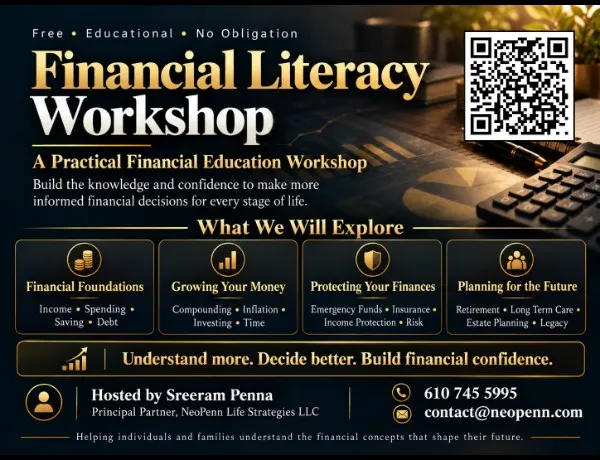
NeoPenn Life Strategies LLC offers a Free Financial Literacy Workshop designed to help individuals and families better understand these basic financial concepts. The goal is not to tell you what financial decisions to make, but to help you better understand the questions, concepts, and options that may influence your financial future.
Learn more about the Financial Literacy Workshop at:
https://financialliteracy.lifestrategies.cc/
NeoPenn Life Strategies LLC
610 745 5995
This material is provided for general educational purposes only and is not intended as individualized investment, tax, legal, or financial advice. Evaluate financial and insurance strategies based on individual circumstances.