Is Financial Services Right for You? A Reflective Framework for Those Exploring Growth and Additional Income
Key Takeaways
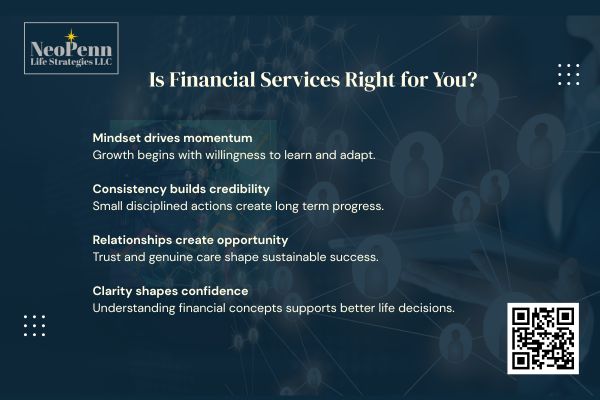
Financial services may suit individuals who are curious, coachable, and willing to build relationships over time.
Long term success in this field is shaped more by mindset, consistency, and emotional intelligence than by prior experience.
Exploring the profession with realistic expectations and values driven intent can lead to meaningful personal and professional growth.
Recognizing the First Signs of Interest
Many individuals who feel naturally drawn to financial services opportunities often share certain early behaviors. They may already be taking responsibility for managing their household finances, exploring investments independently, or showing curiosity about how money systems function.
Interest can also emerge during periods of transition. Professionals seeking additional income, those considering entrepreneurship, or individuals exploring parallel career pathways may begin to reflect on opportunities that offer both flexibility and long-term potential. In many cases, the first meaningful signal is not urgency but curiosity.
Understanding the Mindset Shift Required
Unlike essential services that people actively seek, financial services often require thoughtful explanation before the perceived need becomes clear. This creates a unique professional environment where patience, coachability, and emotional resilience are essential.
Individuals entering this field may need to adjust expectations shaped by previous careers. Success here is often linked not to immediate outcomes but to consistent learning, relationship-building, and the ability to navigate uncertainty without losing motivation.
Considering Life Stage and Personal Priorities
Openness to exploring financial services can vary across life stages. Mid-career professionals who feel limited by current income growth or job security may begin searching for alternative pathways. Others may become more receptive once family responsibilities stabilize and additional time becomes available. Career dissatisfaction, evolving financial goals, or the desire for greater autonomy can all influence the willingness to explore new professional directions. At the same time, intense short-term personal commitments may temporarily reduce the capacity to engage fully.
Learning Beyond Products: Understanding People
Technical knowledge about financial products can be learned with structured training. However, long-term growth in this profession depends more deeply on understanding human behavior. Building trust, recognizing emotional readiness, and supporting individuals through important financial decisions require emotional intelligence and consistent presence. The ability to accept rejection gracefully and continue serving with integrity is often a defining characteristic of those who sustain momentum in this field.
Aligning Expectations with Long Term Reality
One of the most important reflections for anyone considering financial services is the difference between income potential and income certainty. While meaningful financial rewards are possible, they are typically built through disciplined prospecting, relationship development, and long-term commitment. Concepts such as residual income, renewal-based growth, and leadership expansion take time to fully appreciate. Realistic expectations supported by continuous skill development often lead to more sustainable outcomes.
Values as the Foundation of Professional Growth
Financial services can have a profound impact on families and communities when practiced with responsibility and purpose. Individuals who approach the profession with a genuine desire to guide, educate, and support others often experience both personal fulfillment and professional stability.
Conversely, short-term thinking or purely transactional motivation can limit long-term progress. Ethical clarity and a service-oriented mindset help create trust, credibility, and meaningful influence.
Reflecting Before Taking the Next Step
For those wondering whether this path may be suitable, a useful starting point is simple self-reflection. Questions around willingness to learn, patience in building relationships, openness to mentorship, and interest in long-term growth can provide valuable insight.
In many cases, even exploring the profession can deepen financial understanding and support better personal decision-making. A thoughtful conversation or guided introduction may be all that is needed to begin evaluating whether this opportunity aligns with one’s goals and values.
If this perspective aligns with your professional interests and you would like to learn more about the financial services career pathway, connect with me to explore whether this opportunity may be appropriate for your goals and development.
Disclaimer: This content is intended for general educational and informational purposes only. Professional experiences and business outcomes may vary based on individual effort, market conditions, licensing requirements, and ongoing training.