
Living Benefits vs. Health Insurance: Who Pays Your Bills When You Become Seriously Ill?
Your health insurance may help cover your hospital bills. But who helps pay your mortgage, groceries, and everyday expenses if a serious illness disrupts your income?
When families think about financial protection against illness, health insurance is usually the first consideration. While health insurance plays an essential role in covering medical expenses, a serious illness can create financial challenges that extend well beyond medical treatment. Understanding how life insurance with living benefits differs from health insurance may help families make more informed decisions about their financial protection.
Health Insurance: Protecting Against Medical Expenses
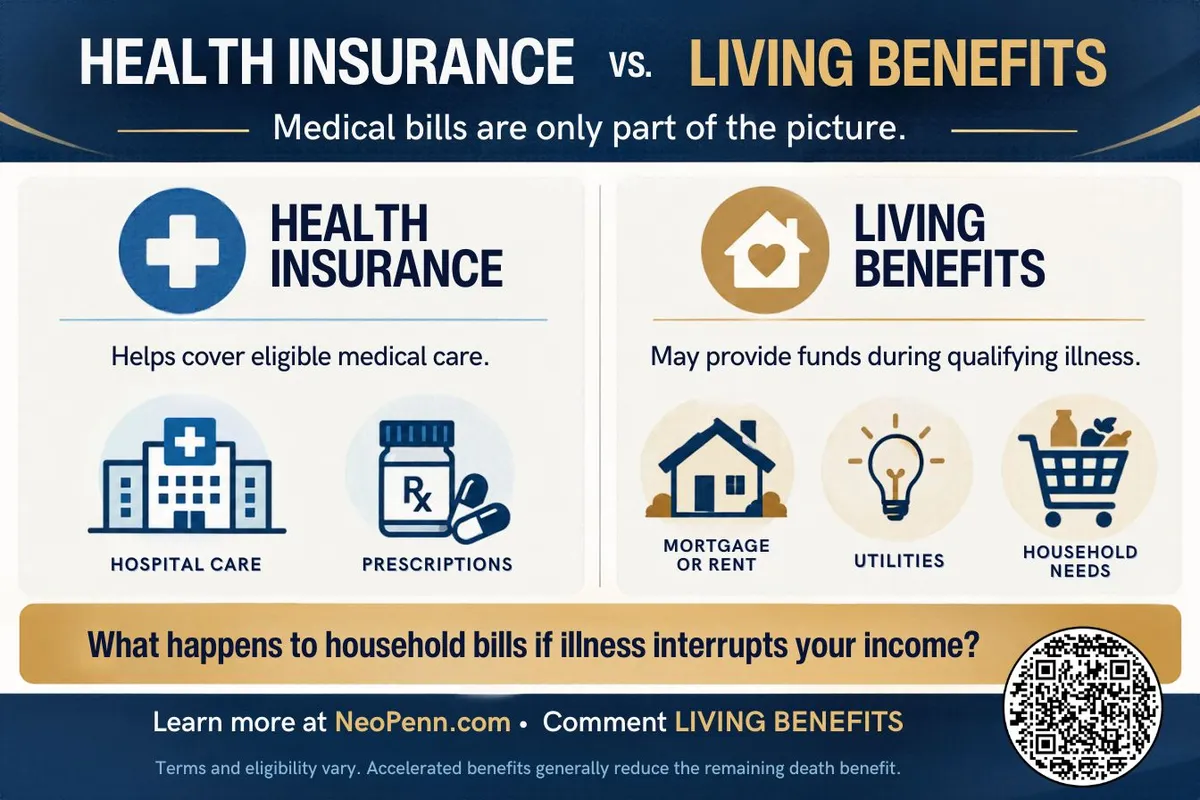
Health insurance is designed to help cover the cost of eligible healthcare services, including hospitalizations, physician visits, prescription medications, surgeries, and preventive care. Depending on the plan, individuals may still be responsible for deductibles, copayments, coinsurance, and expenses that are not covered.
However, medical bills are only one part of the financial impact of serious illness. If an individual is unable to work or requires extended recovery, everyday expenses such as housing payments, utilities, groceries, and transportation generally continue. Health insurance does not ordinarily replace lost wages or pay routine household bills simply because someone becomes ill.
Life Insurance Living Benefits: Understanding Their Purpose
Life insurance is primarily designed to provide financial protection to beneficiaries after the insured person's death. However, certain life insurance policies offer accelerated death benefits, commonly called living benefits, that may allow eligible policyholders to receive a portion of their death benefit while still alive.
Depending on the policy, these provisions may apply when the insured meets specific criteria involving a terminal illness, chronic illness, or certain covered critical illnesses. Eligibility requirements, covered conditions, benefit calculations, and payment options vary among policies and insurers.
When a qualifying benefit is available, the proceeds may offer financial flexibility during a difficult period. Depending on the policy's terms and restrictions, funds could potentially be used toward household expenses, outstanding debts, caregiving needs, or other financial obligations. Unlike health insurance, accelerated death benefits are not generally intended to reimburse individual medical claims.
Why Understanding Both Types of Coverage Matters
Consider a family whose primary income earner experiences a serious medical condition requiring hospitalization and an extended recovery. Their health insurance may help pay for covered medical treatment, subject to the plan's cost-sharing requirements. However, if the illness also results in reduced income, the family may face financial pressures that medical coverage alone does not address.
If the individual has a life insurance policy containing an applicable living benefit provision and satisfies its requirements, an accelerated benefit may provide an additional financial resource. Such payments are not automatic, and the amount available may be substantially different from the face amount of insurance accelerated.
Importantly, accelerated death benefits generally reduce the remaining death benefit available to beneficiaries. Depending on the policy, discounts, charges, or adjustments to policy values may also apply. Accessing these benefits can therefore involve a trade-off between current financial needs and future protection for loved ones.
Can Living Benefits Replace Health Insurance?
No. Health insurance and life insurance living benefits serve fundamentally different purposes and should not be viewed as interchangeable.
Health insurance helps manage eligible medical expenses, while accelerated death benefits may provide access to a limited financial resource under specified circumstances. Living benefits do not provide comprehensive medical coverage, guarantee income replacement, or necessarily cover every serious illness.
Similarly, living benefits should not automatically be considered substitutes for disability income insurance or long-term care insurance. Each type of protection has different eligibility requirements, coverage provisions, and limitations.
Understanding these differences can help individuals evaluate their existing protection and consider whether there are financial risks they have not fully addressed.
Do You Know What Your Current Life Insurance Policy Covers?
Many individuals know the death benefit amount of their life insurance policy but may be less familiar with its additional provisions, exclusions, or eligibility requirements.
Does your policy include living benefits? What medical conditions qualify? How much could potentially be accessed, and what would happen to the remaining death benefit? These are important questions worth exploring before an unexpected illness occurs.
At NeoPenn Life Strategies LLC, we believe financial education begins with understanding the protection you already have and identifying questions that deserve closer attention. Would you like to better understand how living benefits work and whether your existing life insurance includes these provisions? Request an appointment to connect with us and ask about your coverage questions.
Understanding your options today can help you make more informed financial decisions for tomorrow.
Important Consumer Disclosure
This article is for general educational purposes only and does not constitute an insurance recommendation, tax advice, or legal advice. Living benefits are not a substitute for health insurance, disability income insurance, or long-term care insurance. The availability of living benefits, qualifying conditions, eligibility requirements, benefit calculations, costs, exclusions, and payment options vary by insurer, policy, rider, and state. Accelerated death benefits generally reduce the remaining death benefit and may affect policy values. Benefits may be subject to discounts or charges and may have tax consequences or affect eligibility for certain government assistance programs. No benefit is guaranteed unless the policy's contractual requirements are satisfied. Refer to the applicable policy and rider documents for complete details. Insurance products are subject to state availability, licensing, underwriting, and insurer approval.
References
National Association of Insurance Commissioners (NAIC). Life Insurance — Consumer Information.https://content.naic.org/consumer/life-insurance.htm
HealthCare.gov. Find Out What Marketplace Health Insurance Plans Cover.https://www.healthcare.gov/coverage/
Alabama Department of Insurance. What You Need to Know About Accelerated Benefits.https://www.aldoi.gov/consumers/AcceleratedBenefits.aspx
Interstate Insurance Product Regulation Commission. Additional Standards for Accelerated Death Benefits for Individual Life Insurance Policies.https://www.insurancecompact.org/standards/record-adopted-standards/additional-standards-accelerated-death-benefits-individual-life
Internal Revenue Service. Publication 525 — Taxable and Nontaxable Income.https://www.irs.gov/publications/p525
National Association of Insurance Commissioners. Advertisements of Life Insurance and Annuities Model Regulation (Model 570).https://content.naic.org/sites/default/files/model-law-570.pdf